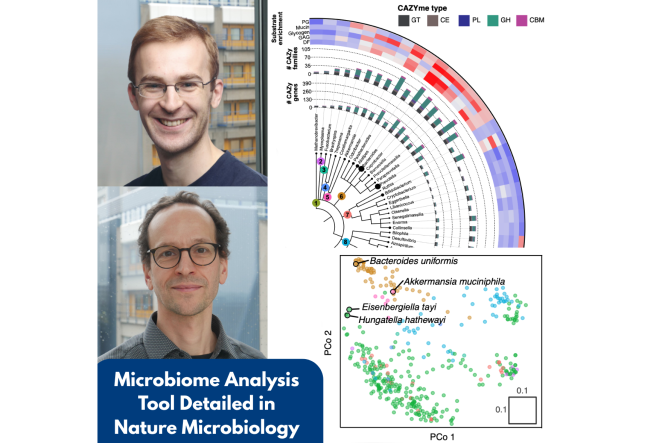
Detailed in a new Nature Microbiology paper named “Cayman enables large-scale analysis of gut microbiome CAZyme repertoires”, Zeller, Quinten Ducarmon, and team have developed an easy-to-use software tool, Cayman, which facilitates analysis of an interesting class of bacterial enzymes in the gut: CAZymes.
Cayman computationally characterises these enzymes, which biochemically break down complex carbohydrates, facilitating the digestion of dietary fibres and complex sugars lining human cells in the gut to establish a protective mucus barrier between the host and gut bacteria. It can be used to study and compare the diversity of CAZymes encoded in bacterial genomes, as well as in metagenomes of complex bacterial communities generated from thousands of stool samples from all over the world.
By using this new tool, the researchers discovered new mucus-digesting bacteria (Hungatella and Eisenbergiella) and, contrary to previous investigations, found that human populations from industrialized countries have a higher richness and diversity of CAZymes for fibre degradation than human populations with a pre-industrialization lifestyle with plant-rich seasonal diets. A decrease of these fibre-digesting enzymes was also found in gut metagenomes of colorectal cancer patients.
Zeller is excited about the future of Cayman: “We see that microbiome researchers have already begun using the tool before the publication of the paper. In the future, Cayman will help us dissect the complexity of gut microbial CAZymes and their adaptation to different diets. This will be key to understanding how diet-microbiome interactions drive disease.”
Read the paper here: https://www.nature.com/articles/s41564-026-02318-2