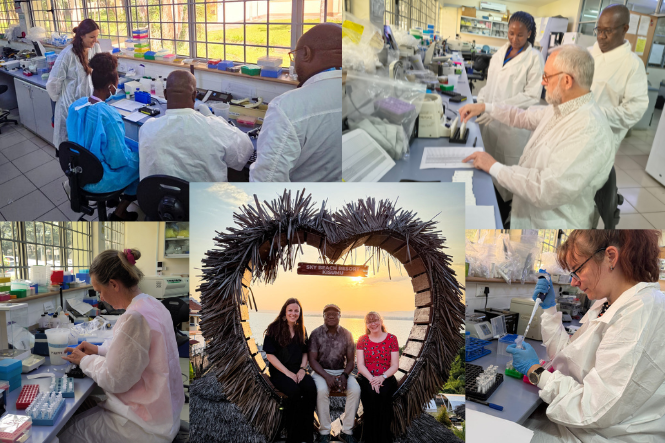
The Flow-S project evaluates a novel diagnostic device developed by Salus Discovery that enables the concentration and detection of circulating anodic antigen (CAA) from large urine volumes. During the visit, urine and serum samples were tested using the highly sensitive UCP-LF CAA assay to evaluate the performance of the new Flow-S device. By comparing results obtained with the UCP-LF CAA test, the project aims to determine whether the Flow-S device can provide a practical and reliable approach for improving schistosomiasis diagnosis, particularly in individuals with low-intensity infections where conventional diagnostic methods often lack sensitivity. This work is an important step towards making highly sensitive CAA detection more practical for research and, ultimately, wider implementation.
In addition to processing samples, the visit focused on capacity strengthening. Two members of the KEMRI NTD team received hands-on training in performing the UCP-LF CAA assay, and it was great to see how fast they were able to learn the technique. Their first CAA results were already very good, highlighting both their enthusiasm and the value of building local expertise for future diagnostic studies.